Australia’s Mandatory Sustainability Reporting Begins January 2025 [Complete PDF Guide]
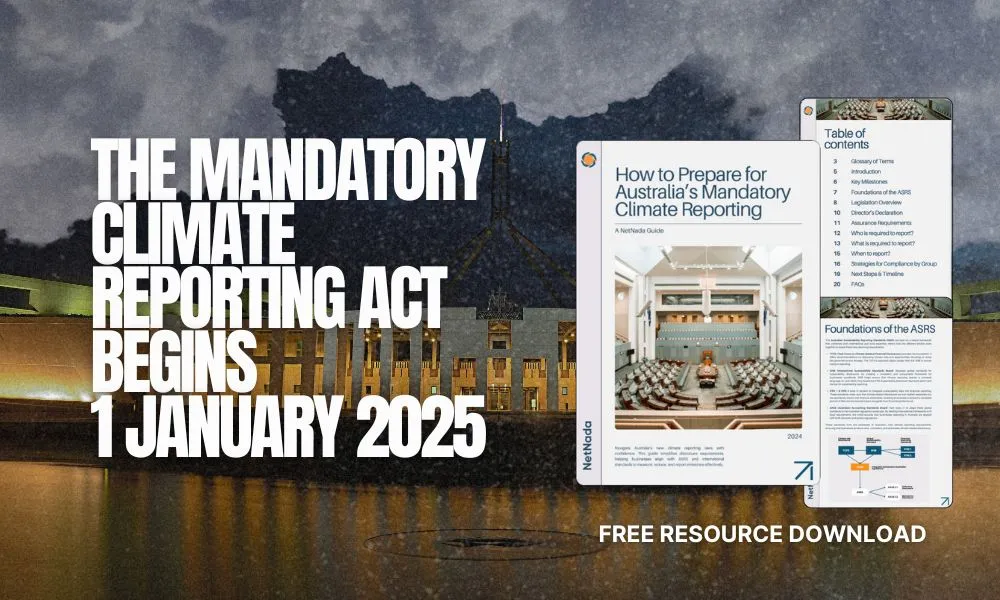
The year 2025 signals the start of important action for Australian businesses, as the federal government rolls out mandatory climate reporting requirements. This shift aims to align Australia with global sustainability standards, placing greater emphasis on transparency, accountability, and emissions reduction. If you’re wondering how these changes will affect your business or how to prepare, our guide on How to Prepare for Australia’s Mandatory Climate Reporting is here to help.
 Free Download: NetNada Guide on Australia’s Mandatory Climate Reporting## Why Climate Reporting is Mandatory
The introduction of mandatory climate reporting reflects Australia’s commitment to global sustainability frameworks, such as the International Sustainability Standards Board (ISSB). The new regulations will require businesses to disclose their Scope 1, 2, and 3 emissions, alongside governance, strategy, risk management, and key metrics related to climate risks and opportunities. These requirements aim to:
- Drive decarbonisation across industries.
- Improve corporate transparency for investors and stakeholders.
- Enhance resilience to climate-related financial risks.
Businesses need to adapt quickly, as reporting will first apply to large corporations and progressively expand in scope.
What Businesses Need to Know
Starting January 2025, companies meeting [specific thresholds](https://www.netnada.com.au/post/new-decade-for-climate-reporting-australia-government-passes-climate-reporting-act#:~:text=Large%20Companies%20(Group,July%202027.) will need to submit detailed climate-related disclosures. Key components include:
- Governance and Strategy: Demonstrating how climate risks and opportunities are integrated into business strategy.
- Scope 1, 2, and 3 Emissions Reporting: Measuring direct emissions, indirect emissions from purchased energy, and emissions across the supply chain.
- Dual Scenario Analysis: Assessing how climate-related risks and opportunities impact your business under two global warming scenarios.
This comprehensive approach ensures businesses account for their environmental impact and adopt strategies to mitigate risks.
Preparing for Compliance
Compliance may seem overwhelming, but taking proactive steps now will ensure your business is ready. Our guide breaks down strategies and specific steps to take for each group – ensuring that we are able to support all business sizes.
Why Download the Ultimate Guide to Australian Climate Reporting
Navigating these new regulations can be challenging. Inside our guide, you’ll find:
- A comprehensive timeline of mandatory reporting requirements.
- Step-by-step strategies for each group to prepare your business.
- Answers to frequently asked questions about compliance.
- and more
This guide is designed to empower businesses of all sizes to confidently meet their climate reporting obligations while driving sustainability goals.
 How to Prepare for Australia’s Mandatory Climate Reporting in 2025 contents## Get Ahead of 2025: Download the Guide Now
Don’t wait until the deadline is looming—start preparing for mandatory climate reporting today.
Download the guide now and equip your business with practical steps needed for compliance success.
Start Your Climate Reporting Journey
Join 1,000+ Australian businesses using NetNada for carbon accounting and sustainability reporting.