The Carbon Neutral Standard 2026
The Carbon Neutral Certified Standard represents an independent leading approach and certification to climate action and emissions measurement by companies, events, and projects.
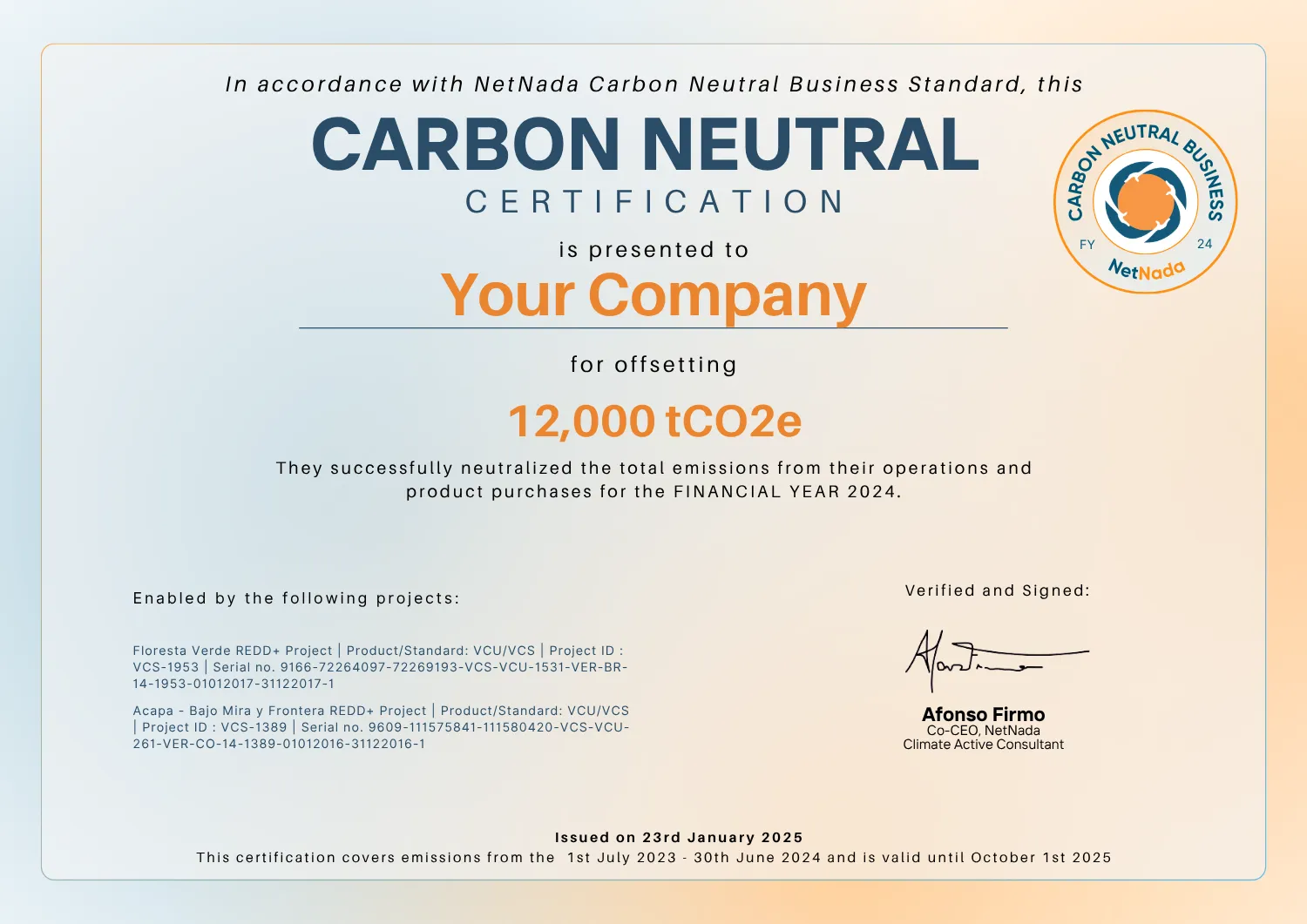
Key Terms
NetNada Carbon Neutral Certified Standard (NCNS)
All information contained in this document.
Carbon Neutral Business Certified Label
What businesses receive upon meeting the standard.
Carbon Neutral Event Certified Label
What events receive upon meeting the standard.
NetNada Approved Certifiers (NAC)
Entities verifying information for large organisations.
How to Apply
Companies must follow the NetNada Carbon Neutral Certified Standard (NCNS), apply for certification, and receive formal approval from NetNada Approved Certifiers (NAC) in order to be licensed to use the Carbon Neutral Certified label.
Eligible Certifying Entities
The standard applies to corporate entities, subsidiaries, or brands. Individual products or services are not eligible. Companies in restricted sectors cannot pursue certification. Events and film projects may qualify for separate certifications.
Measurement
a. Measurement Boundaries
Entities must track cradle-to-customer emissions for the full 2025 calendar year or overlapping fiscal year (minimum six months overlap). Tracking includes:
- All Scope 1 emissions
- All Scope 2 emissions
- 8 of 15 Scope 3 categories
Finance & Investment Firms Note
Entities deriving at least 5% revenue from financial holdings must also measure Scope 3.15 emissions (asset managers, banks, insurance companies, REITs).
b. Data Requirements
Activity/physical data (litres of fuel, kWh electricity, km travelled, material kilograms) is encouraged for Scopes 1 & 2 over estimated data.
Companies outside the Small Company Pathway must use activity data for Scopes 1 and 2 beginning in their second certification year for emissions representing 5% or more of total footprint.
c. GHG Measurement and Verification
Three Verification Pathways by Company Size:
Under $5 million revenue
- Estimate emissions using NetNada Carbon Management Platform (NCMP)
- Submit complete inventory with signed attestation
- No third-party verification required
$5–100 million revenue
- Create emissions report by scope and category
- Can use NCMP, external calculator, consultant, or in-house tool (must comply with GHG Protocol)
- Submit complete measurement report
- Submit signed good-faith document confirming accuracy and completeness
- No independent verification required
Over $100 million revenue
- Create comprehensive emissions report
- Third-party verifier must review inventory
- Submit complete measurement report
- Submit good-faith attestation
- Submit third-party verification report
d. Third-Party Verification Requirements
All verification reports must follow five principles: relevance, completeness, consistency, transparency, and accuracy.
Verification must conform to: ISO 14064-3, ISAE 3000, ISAE 3410, or Corporate GHG verification guidelines from ERT. Reports must specify level of assurance: limited or reasonable.
Third-party verifiers must demonstrate:
- Minimum five years corporate history in carbon accounting/lifecycle analysis with 25+ documented client engagements
- Minimum five years auditing/verifying corporate GHG footprints for companies exceeding $100 million annual revenue
- Independent control and ownership from reviewed company
- Ability to act as unbiased third party
- Minimum five years experience with one or more referenced verification standards
e. Renewable Energy Purchases for Scope 2
Renewable Energy Certificates (RECs) bundled or unbundled with energy purchases can make market-based adjustments to electricity emissions.
Vintage requirements: Certificates must be purchased within certification year or one year prior. For 2025 emissions, RECs must have 2024 or later vintage. All RECs must be attributed to same grid subregion as Scope 2 electricity consumption.
f. Corrections to Measurement Reports
Errors/omissions exceeding 5% materiality threshold require restatement of affected year(s).
Lower Restated Emissions: Companies may bank surplus carbon credits for future certification years, provided they comply with current standard requirements.
Higher Restated Emissions: Companies encouraged to address shortfalls in carbon credit purchases for continued compliance.
Reductions
a. Reduction Action Plan Requirements
All organisations must develop a Reduction Action Plan using Change Climate's template, demonstrating:
- At least two initiatives reducing emissions within 12–24 months
- At least one initiative for employee sustainability education
- For entities exceeding $5 million revenue: at least one measure targeting Scope 3 emissions
- Annual progress reports on previous initiatives for recertification
Science-Based Target Setting
Organisations with over $100 million annual revenue must establish 2030 science-based reduction targets covering all Table 1 emissions:
- Default: 50% reduction from 2025 baseline
- Endorsed Science-based Targets Initiative target
- Well-documented, sector-specific science-aligned target
Entities under $100 million revenue are strongly encouraged, but not required, to set science-aligned 2030 targets.
b. Checkpoint Year Requirements
Success evaluated in 2027 and 2029 checkpoint years.
2027 Goals
- All RAPs set through 2025 complete
- Clear progress reporting toward year-over-year emissions reductions
- Roughly 50% progress toward 2030 target requirements (if applicable)
2029 Goals
- All RAPs established through 2028 complete
- Roughly 80% progress toward 2030 target requirements (if applicable)
Failure to match exact checkpoint goals may be explained by demonstrating significant pending reduction actions or separate, clear reduction plan with custom baseline/target years.
Compensation and Offsets
a. GHG Mitigation Beyond Value Chain Requirements
Certifying entities must contribute to greenhouse gas mitigation projects proportional to measured emissions. Carbon inventories may be adjusted with clean energy purchases via eligible Energy Attribute Certificates (RECs or GOs).
All carbon credits/EACs must meet:
Third-party Verification
Verified to Gold Standard, Verified Carbon Standard, Climate Action Reserve, American Carbon Registry, or European Biochar Certificate standards.
Vintage Year Restriction
Except forestry/land-use: Credits must represent avoided emissions/removals within four years up to and including emissions year. For 2026 certification of 2025 emissions: 2022–2025 vintages qualify.
Forestry/land-use: Credits must represent reductions within seven years, including 2019–2025 vintages. No project start date requirements, provided vintage requirements are met.
b. Portfolio Requirements
Carbon credit purchases must come from approved project categories. Allocations are encouraged but not required to follow suggested targets.
Disclosure
a. Information Disclosure Requirements
Companies with active certifications must publicly disclose on NetNada Brand Profile Directory:
- 1 Total annual GHG footprints by Scope 1, 2, and 3 emissions
- 2 For recertifying entities: Total annual emissions intensity for prior years (beginning 2025 certifications) with any corrections/adjustments; historical absolute emissions by scope strongly encouraged
- 3 Total annual investment (USD) in carbon removal/avoidance credits and project types supported
- 4 Certified products/services categories
- 5 Reduction action plans summary and science-aligned targets (if set)
- 6 Progress toward past reduction action plans
Advocacy
Climate Advocacy Reporting Requirements
Certified entities are strongly encouraged to engage in lobbying, education, and stakeholder mobilisation for climate solutions. Applications require reporting prior calendar year activities (not public).
Activities should include one or more of:
Climate Lobbying
Support climate policy at political level directly or via advocacy/trade organisation collaboration.
Internal Climate Literacy
Engage team through NetNada Sustainability Academy; conduct education sessions increasing staff climate understanding.
Consumer Climate Literacy
Engage consumers in Climate Action plan process and climate action importance.
NetNada Carbon Neutral label usage constitutes advocacy. Recertifying companies must provide at least one example of label usage in digital or real-world settings.
Ready to Get Certified?
Chat with our team to learn more about the NetNada Carbon Neutral Certified Standard and how to apply.